Minimalist Landscape Painting: What Gets Left Out, and Why
· Ani Muradyan
What a minimalist landscape removes, what it asks you to supply, and why quiet is not the same as empty — with four paintings by Ani Muradyan.
A minimalist landscape gives you less to look at than you expect. A horizon. Perhaps a single figure. A field of colour that resolves into ground and sky mostly because you have decided it does. Often there is no path for the eye to follow, no incident in the middle distance, nothing labelled.
This is usually the point at which someone asks whether the painting is finished.
What minimalism is describing
In a landscape, minimalism is a decision about how many elements a picture needs. Detail is removed. The palette narrows. The composition comes down to a few relationships — a horizon against a plane, a small form against a large one, one temperature of colour against another.
That is a description of method, not a claim about quality. It also leaves open what the remaining elements are doing, which is easier to see in particular paintings than in the abstract.
Quiet is not the same as empty
The Armenian contemporary painter Ani Muradyan, whose landscapes are built this way, states the distinction directly in her account of her practice:
For me, minimalism is not emptiness. It is not a lack of feeling. It is a form of maturity. It is the moment when an artist no longer needs to say everything loudly. A single line can carry what ten lines once tried to explain. A quiet field of colour can hold an entire emotional landscape.
Her point is about volume rather than quantity. The reduction is a choice about how loudly to say something, not a sign that there is less to say.
What the painting leaves you to supply
Reduction leaves more for the viewer to do. Remove the landmarks and the sense of scale goes with them, so you place yourself in the picture rather than being placed by it.
No Measure for Distance (oil on canvas, 119×99cm, 2026) is a clear instance. Muradyan's description of the painting sets out both what is there and what is withheld: "The horizon opens into a wide, almost boundaryless landscape, where a solitary figure appears small against the surrounding space. With no clear route or sense of scale, the scene captures the uncertain freedom of being between places — no longer held by what was familiar, but not yet knowing what comes next".
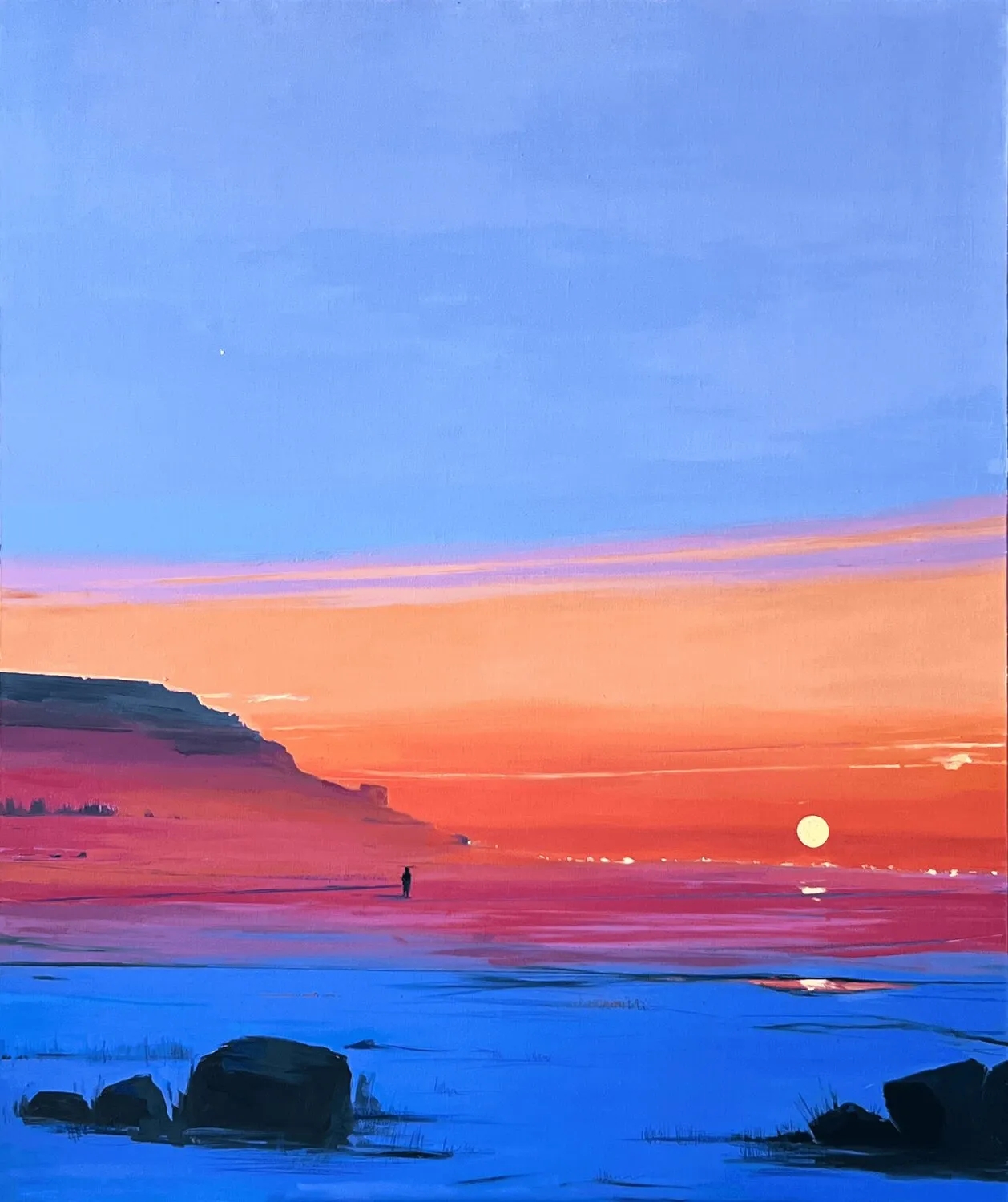
In her account the missing route is not something left undone. It is what the painting is about.
Restraint is a colour decision too
Minimalism in a landscape is not only about how much is depicted. It is also about how narrow the palette is, and what happens where two colours meet.
Quiet Pathway (oil on paper, 36×28cm, 2026) works this way at small scale. Muradyan describes exploring "the serene interplay of shadows and light, which dance across a meandering pathway and the lush landscape surrounding it". Of her method she writes: "I utilized a minimalist approach, juxtaposing vivid greens against moody blues to evoke a deep, contemplative stillness".

Two colour families, and one relationship between them. She attributes the stillness to that juxtaposition rather than to quiet colour: the greens are vivid and the blues are moody, and the calm comes from setting them side by side.
Minimal does not mean muted
Restraint in form does not require restraint in colour.
Path to Tranquility (oil on canvas, 79×71cm, 2026, now in a private collection) is reduced in structure and strong in colour. Muradyan writes that she used "a minimalist approach", layering oil paints "to capture the expansive sky and reflective water". Of the result she says: "The contrasting bold colors at twilight bring a vibrant yet soothing energy".
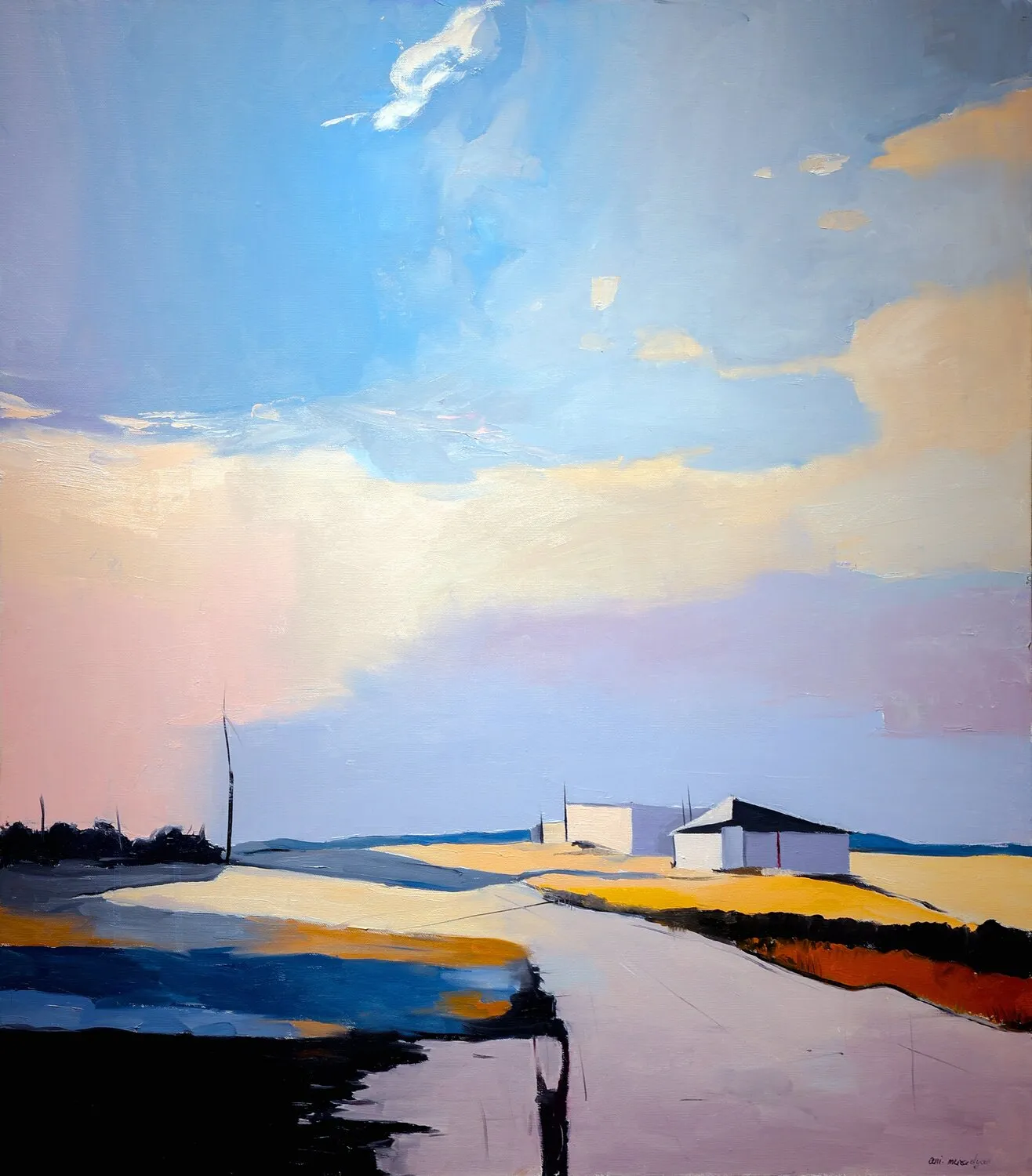
What is reduced here is the number of things depicted — sky, water, and little else. The colour is not reduced at all.
A horizon can be suggested rather than drawn
Once enough is removed, a landscape stops depicting a view and starts implying one.
Serenity in Layers (oil on canvas, 61×71cm, 2026, now in a private collection) sits at that edge. Muradyan describes it as capturing "the tranquil beauty of an abstract landscape, using soft pastel tones and textured brushstrokes". She adds that its "layered composition suggests a peaceful horizon".

Her word is suggests. The horizon is not drawn as a line; it appears where two areas of colour meet. This is the point at which minimalist landscape painting starts to overlap with abstraction.
A landscape that may not be a place
The landscape is often not the subject at all. Muradyan is direct about this:
Although landscapes became more present in my work, I was still painting the inner world of a person. A landscape, for me, is never only a place. It can be a state of mind, a memory, a longing, a pause, or a movement toward something more honest.
Taken literally, that changes what there is to look for. If the horizon stands for a state rather than a location, the place is not the subject, and there is no view to identify.
How to look at one
Give it longer than it appears to need. Look for the few relationships that have been left in — where the horizon sits, how much of the canvas is quiet, where two colours actually meet. Then ask what would change if one more element were added.
If you would like to spend time with work made this way, Ani Muradyan's original oil paintings include several minimal landscapes, and her own account of how the approach developed is in The Path.